

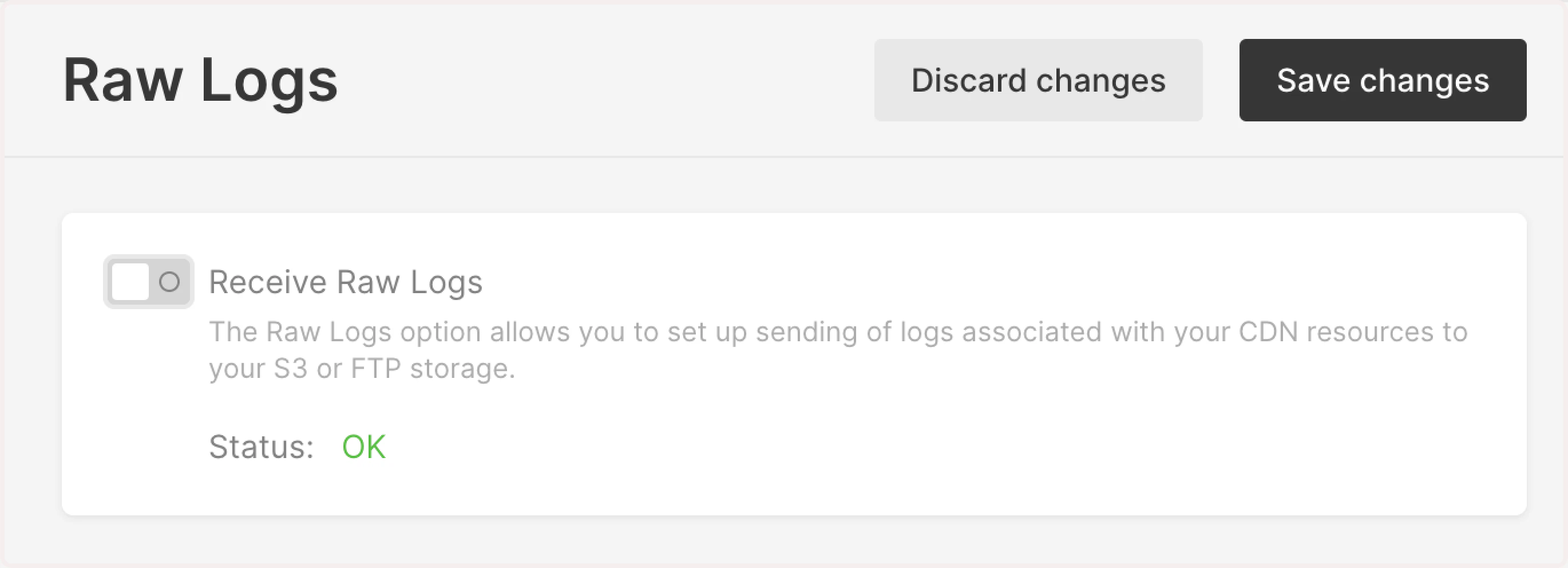
InfoThis is a paid feature. To activate Raw Logs, contact the Gcore support team. After activation, enable Raw Logs in the Gcore Customer Portal and configure export to S3, FTP, or SFTP storage.
Raw logs settings
In this section, you can find general information about log settings, overview of log statuses, and details on how Raw Logs are exported and calculated.Add logs from origin shielding
If you are using the Origin Shielding feature, you’ll see the Add logs from origin shielding checkbox when configuring logs. We recommend that you select this option as it ensures that the logs report will include both requests to cache services and requests to the pre-cache server. Thus, you’ll receive more detailed information on resource usage. When setting up Raw Logs, select the checkbox to enable Add logs from origin shielding.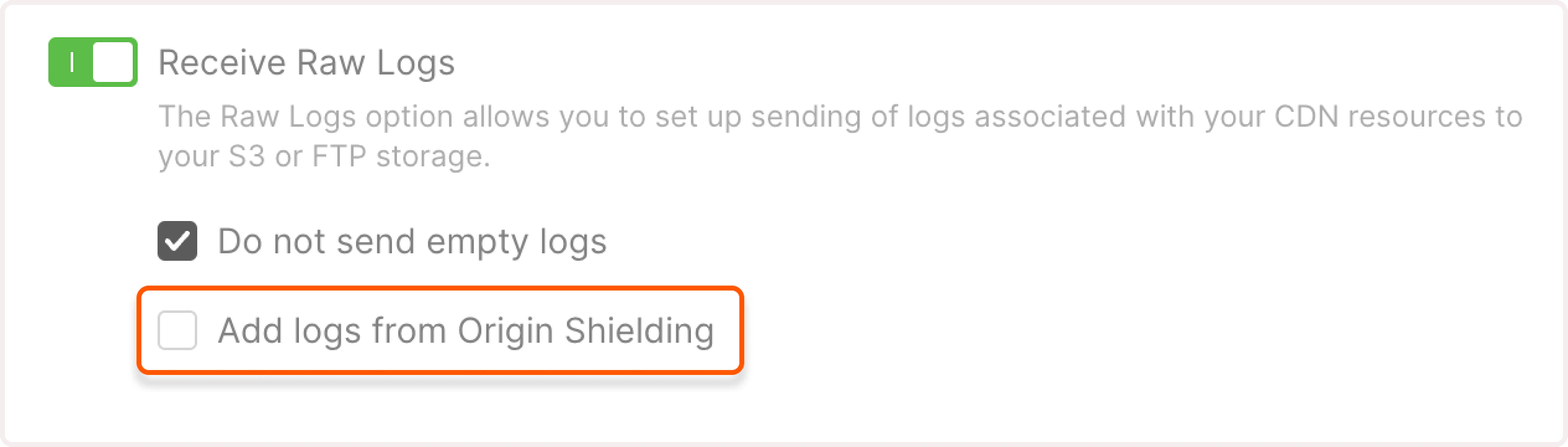
Raw logs statuses
You can check the status of the Raw Logs in the Gcore Customer Portal:- Pending : A status for the time interval between the connection to storage and the first log export.
- OK : Logs are exported from at least one CDN server.
- Failed : An error occurred while connecting to a storage, or the service failed to export logs within 24 hours.
- Pause : The Raw Logs feature is paused.
Export time intervals
Logs are exported at the end of each hour. If you activate Raw Logs at 00:30, the first logs will be exported between 00:45 and 01:00 and the next ones—between 01:45 and 02:00. If CDN servers are not requested and you didn’t select the Do not send empty logs checkbox when configuring Raw Logs, an empty log file (± 20 bytes) will be sent to your storage.Log traffic calculation
Logs can generate various types of analytics, such as delivered traffic. To understand what the totals mean, we recommend that you familiarize yourself with the formulas for calculating logs. For details about CDN reports, check out the View statistics on CDN resources guide. The formula for calculating traffic depends on whether you’ve selected the Add logs from origin shielding option for Raw Logs.If Origin Shielding is disabled
If Origin Shielding is disabled
If this feature is disabled, the formula will look like this:Where:
upstream_bytesare equal to the$upstream_response_lengthlog field and refer to the response length from an origin in bytessent_bytesare equal to the$bytes_sentlog field and refer to the number of bytes sent to a user from the edge (cache) servers
$upstream_response_length is 10485760 (bytes) and $bytes_sent is 1514848 (bytes), the final value in the Raw logs report will be 12,000,608 (bytes).If Origin Shielding is enabled
If Origin Shielding is enabled
If this feature is enabled, the formula will look like this:Where:
upstream_bytesare equal to the$upstream_response_lengthlog field and refer to the response length from an origin in bytessent_bytesare equal to the$bytes_sentlog field and refer to the number of bytes sent to a user from the edge (cache) serversshield_bytesare equal to the$bytes_sentlog field and refer to the number of bytes sent to a user from the pre-cache server
InfoThe final value of log data may differ slightly from the billing statistics as there may be cases where not all logs are received, such as: * You are using the Origin Shielding feature but didn’t select the Add logs from origin shielding option. * You have a rate limit set on your storage side, and when CDN started generating logs, some logs weren’t downloaded because of the rate limitation.
Log path example
Log example
Log format
Log fields
The following table contains a complete list of available log fields. Fields formatted in italics relate to our internal CDN system, so you can ignore them. You can check other fields—they can be helpful for traffic analysis or statistics.View log fields
View log fields
Export logs to S3 storage
- Amazon storage
- Non-Amazon storage
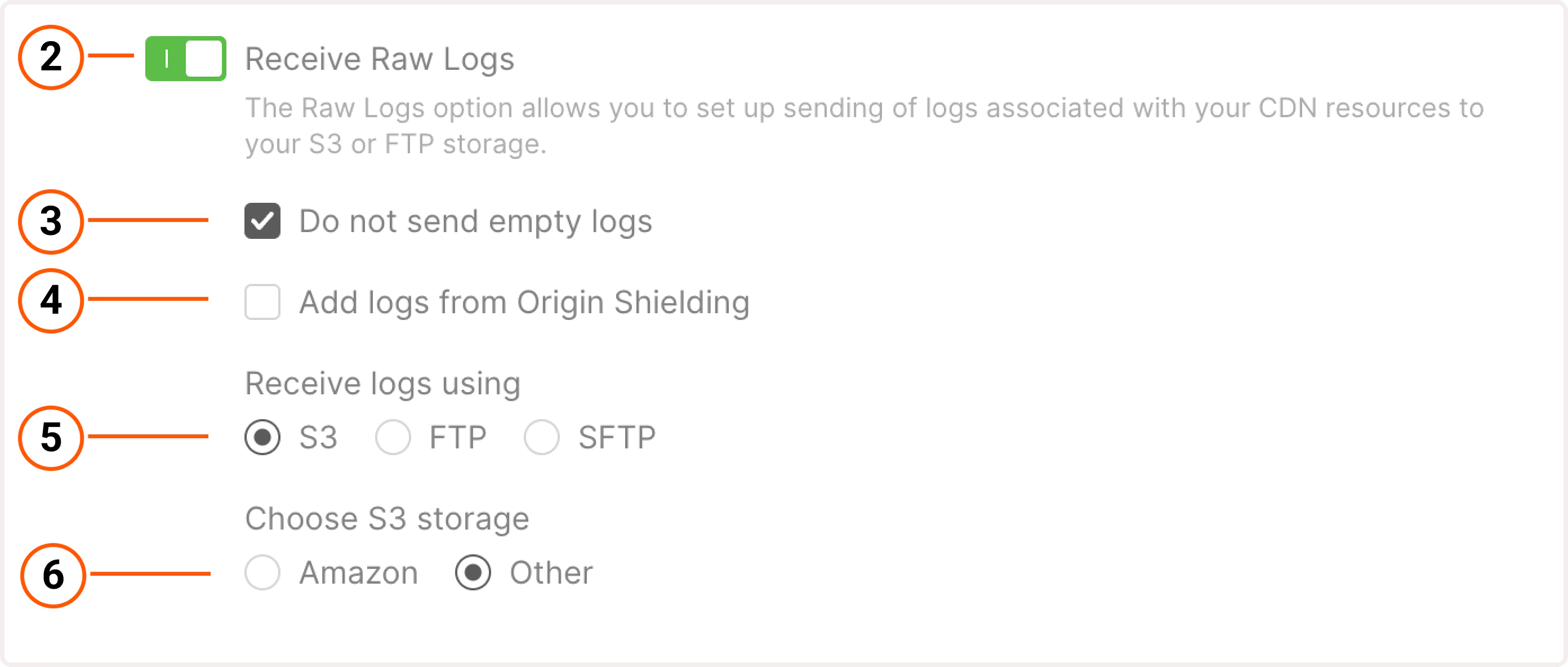
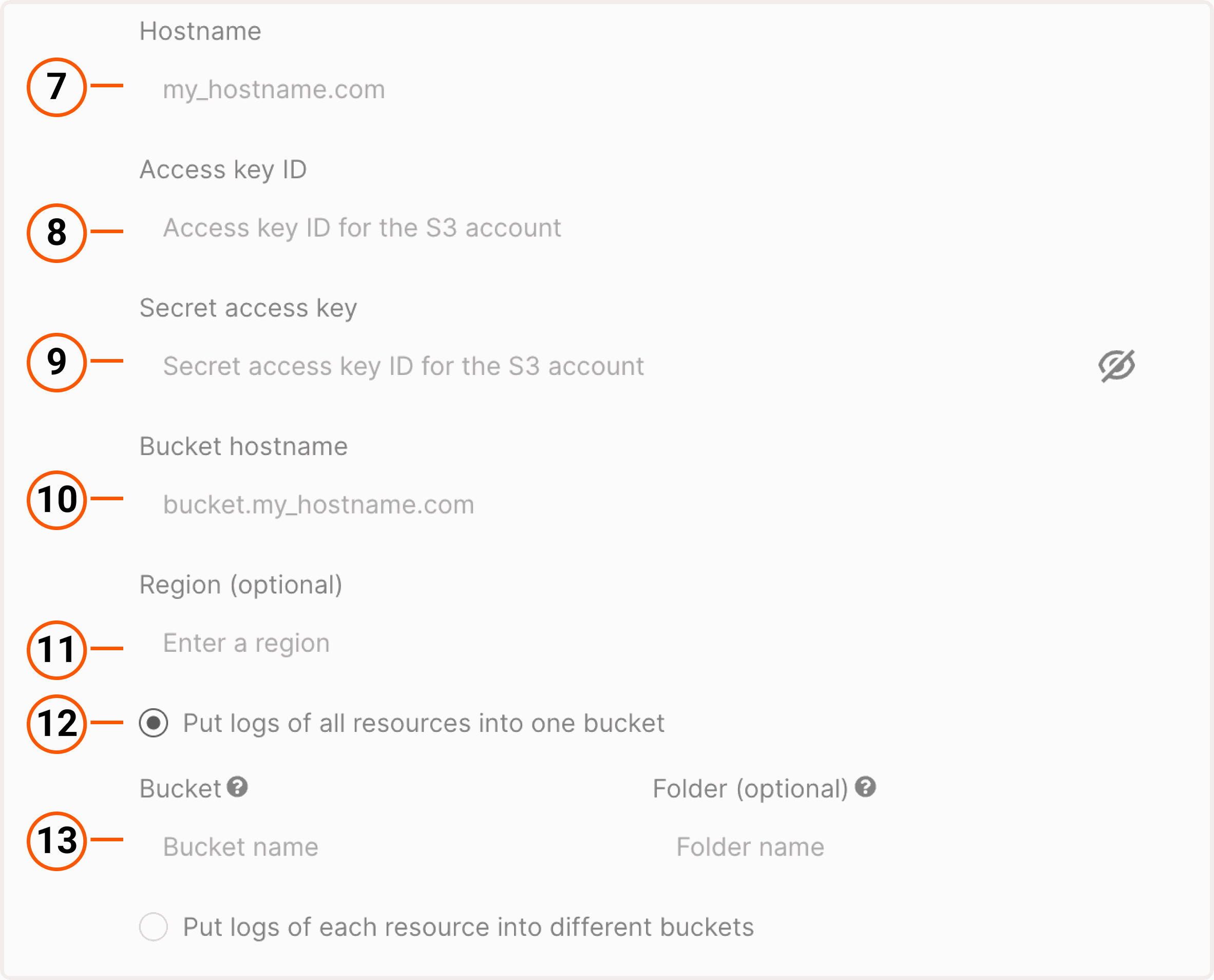
1. In the Gcore Customer Portal, navigate to CDN > Logs.2. Enable the Receive Raw Logs toggle to open log settings.3. Keep the Do not send empty logs option selected if you don’t want to receive empty logs. Otherwise, uncheck it.4. If you use our Origin Shielding feature, you’ll see a checkbox Add logs from origin shielding. Select the checkbox to receive logs from both edge servers and pre-cache shielding servers.5. Select to receive logs using S3.6. Choose Amazon as the storage type.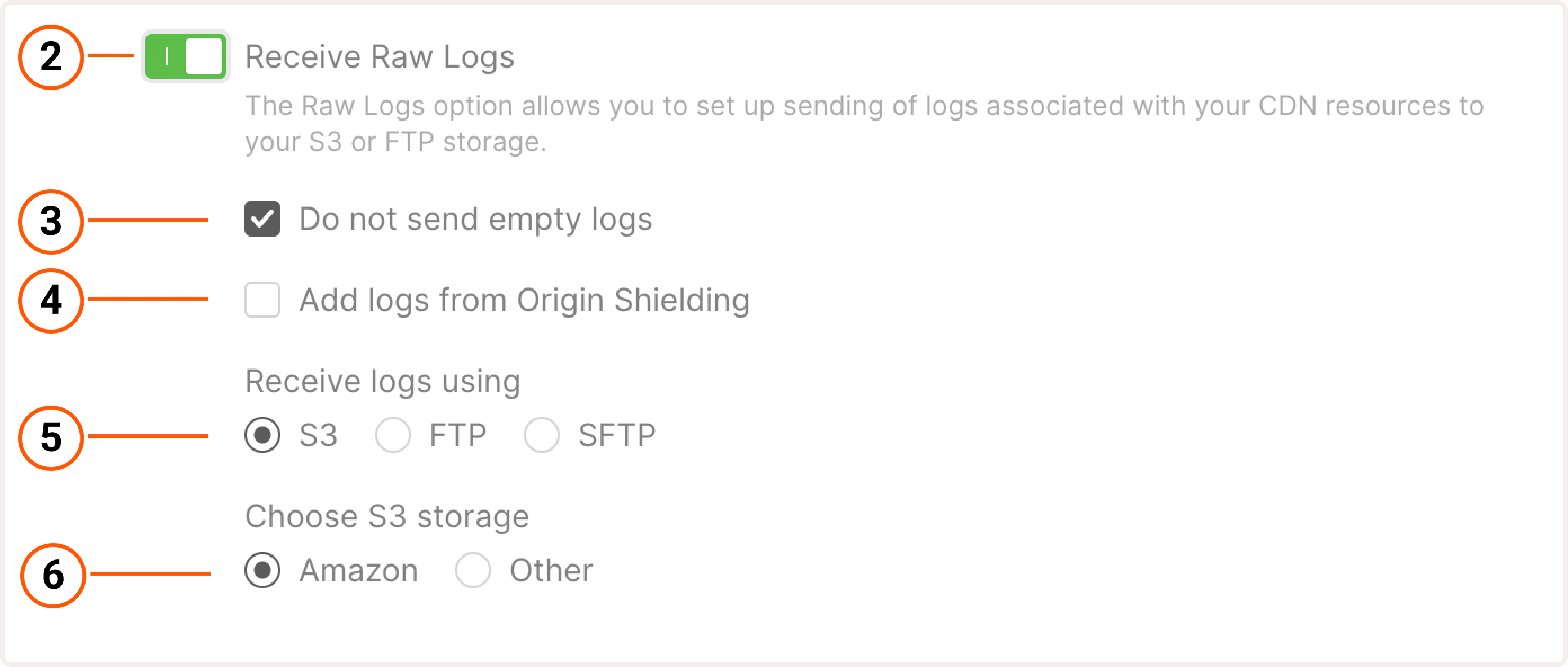
Enter a folder name if you want to export logs to a specific folder within a bucket.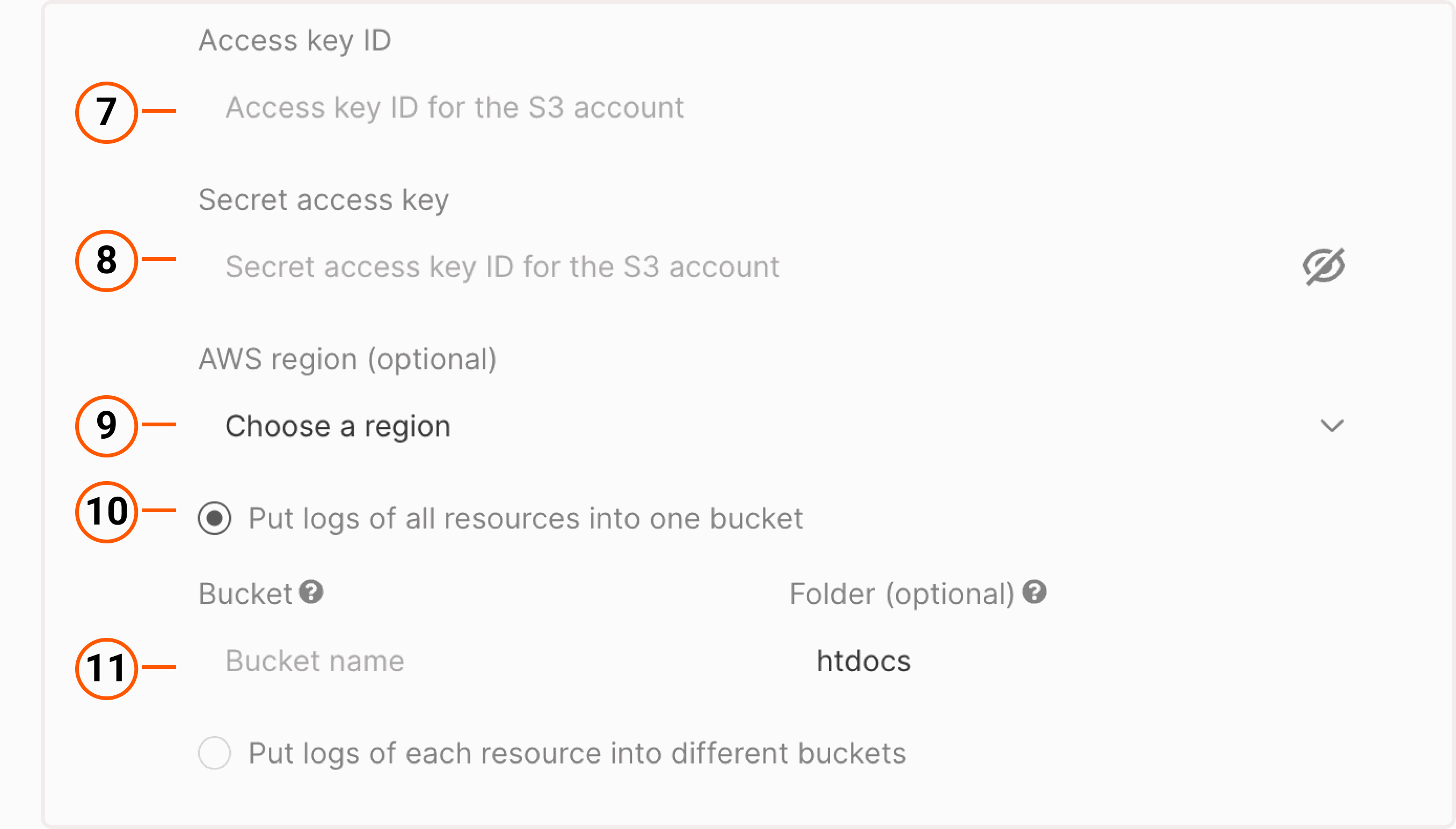
Enter a folder name if you want to export logs to a specific folder within a bucket.
Export logs to FTP or SFTP storage
1. In the Gcore Customer Portal, navigate to CDN > Logs. 2. Enable the Receive Raw Logs toggle to open log settings. 3. Keep the Do not send empty logs option selected if you don’t want to receive empty logs. Otherwise, uncheck it. 4. If you use our Origin Shielding feature, you’ll see a checkbox Add logs from origin shielding. Select the checkbox to receive logs from both edge servers and pre-cache shielding servers. 5. Select to receive logs via SFTP.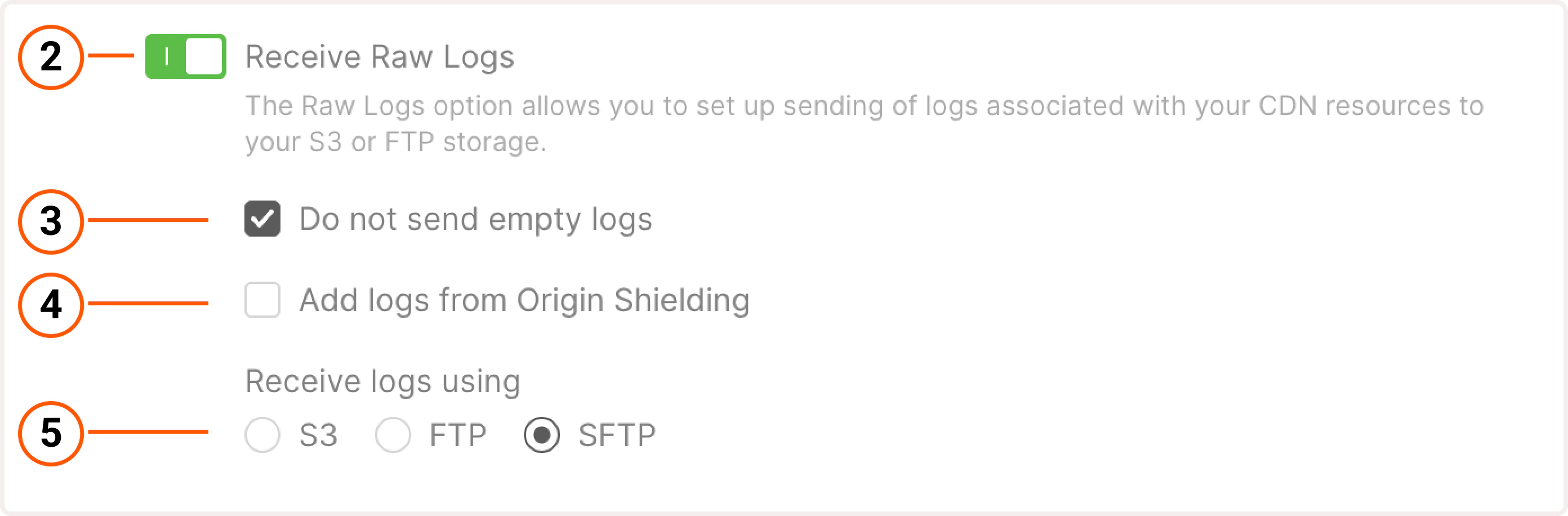
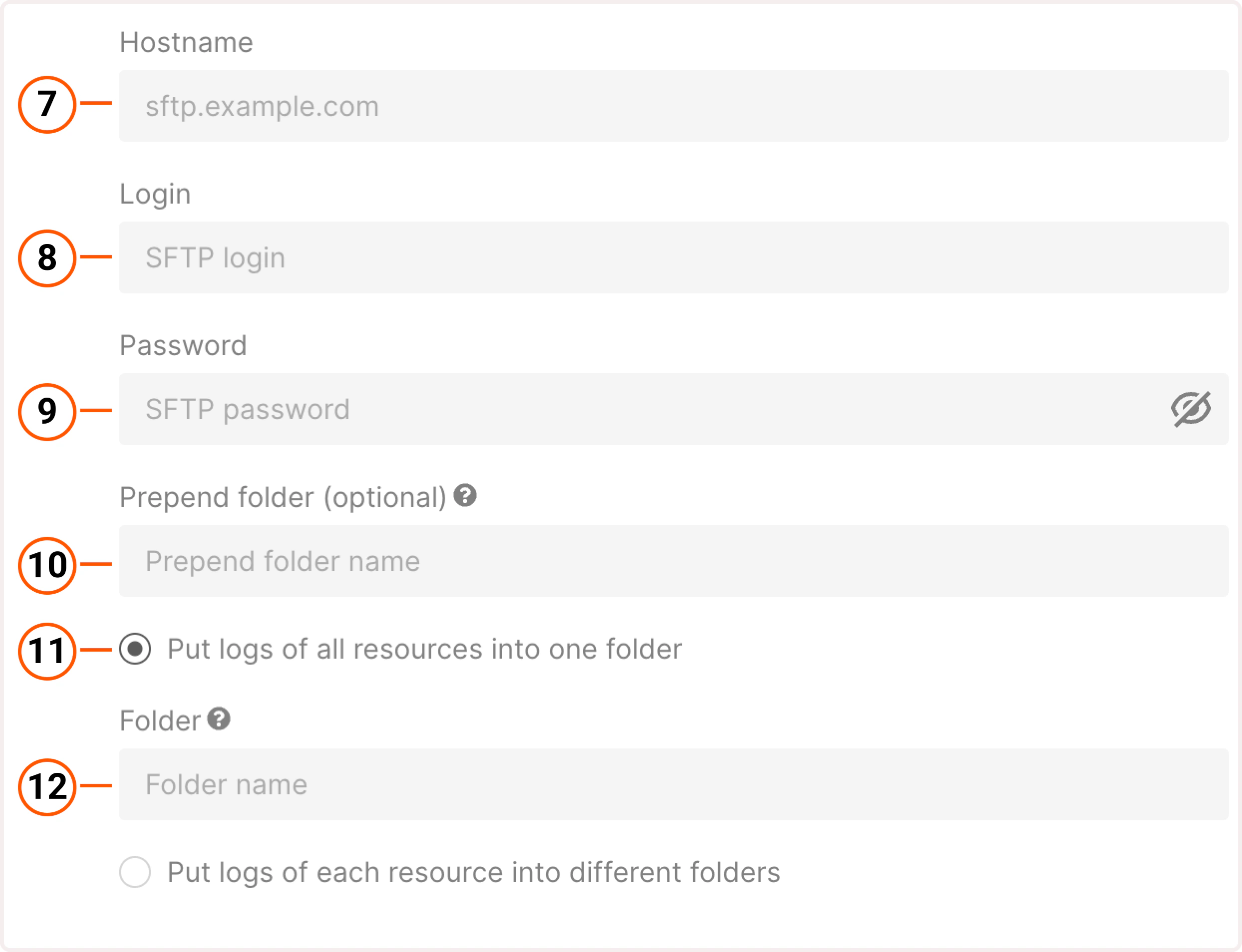
ams.origin.gcdn.co.
7. Specify a username you use to log in to the storage. If you use Gcore SFTP storage, you can find the username in the Details of your storage in the Storage/User name field.
8. Enter the password you use to authenticate to the storage.
9. Specify a folder for export. If you use Gcore SFTP storage, specify the root (home) folder where other folders originate from. You can find its name in the Details of your storage at the end of the Upload path field.
If you use an SFTP storage from another provider, clarify whether a root folder that includes other folders is created by default. If not, leave the field empty. If yes, specify a folder name.
InfoIf you’re using the Gcore SFTP storage, you won’t be able to write to the home folder. It only receives logs and can’t be manually modified.
Deactivate raw logs
To stop Raw Logs delivery, disable the Receive Raw Logs toggle. If you disable the logs, your settings will be saved. You can always activate the same configuration by enabling the Receive Raw Logs toggle again. If you made any changes to the configuration, click Discard changes to cancel any changes made during the editing process.